




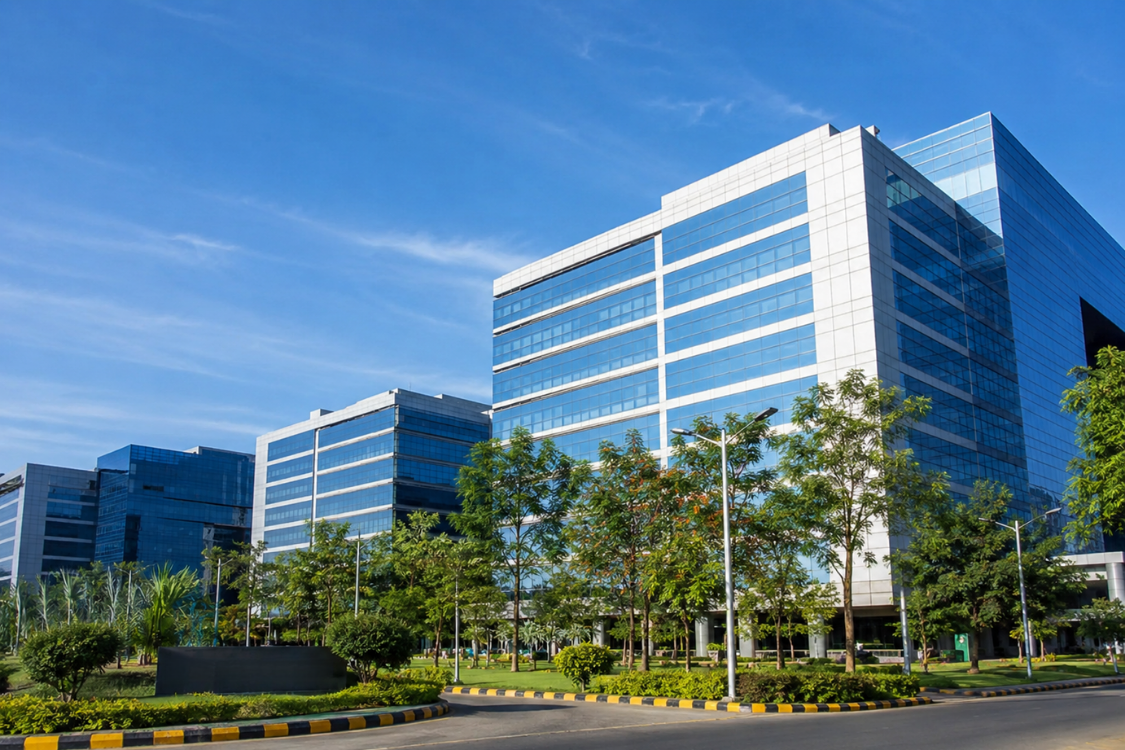
Every month, the electricity bill for a commercial technology campus in Hyderabad included a line that no one had ever questioned.
The three chillers running on the rooftop had been there for fifteen years. They kept the building cool. Tenants stayed comfortable. The bill was paid. For most building owners, that is where the conversation ends.
This one went further.
The campus is a live, multi-tenant IT park. Its occupants run continuous operations, and air conditioning is not a negotiable service; it is the reason leases get signed and renewed. The chiller plant ran around the clock to deliver it, consuming 32 lakh kWh of electricity every year.
The building management team had been watching that number. The chillers were running fine. The question being asked was whether they were running as efficiently as current technology would allow, and whether the gap, if there was one, was large enough to act on.
“Our tenants expect a well-run, modern building. What we didn’t know until we measured it was how much we were paying above what was necessary to deliver that.” — Building Manager, Technology Campus, Hyderabad
The answer, once measured, was unambiguous. At 1.64 kW/TR, the plant was operating 39% above modern efficiency benchmarks. The gap was not a rounding error. It was a structural cost embedded in every hour of operation for 15 years.
Closing it required two things: the technical capability to redesign the plant correctly, and a financing structure that didn’t require the building owner to commit capital upfront.
The tech park found both in Energeia.
Under Energeia’s E-Chill Cooling-as-a-Service model, Energeia funded, built and operated the upgraded plant. And the entire chiller system was replaced without a single rupee of the owner’s capital spent. The execution risk stayed with Energeia. For the building facility management, this was a major win as they now had brand new energy-efficient HVAC equipment, and paid only for their actual cooling energy consumption, not the inefficiency of their machines.
Key Stats
- ₹1.1 Crore+ Annual Monetary Savings
- 11,70,000 kWh Annual Energy Savings
- ~831 Tonnes CO₂ Emission Reduction
Customer Overview
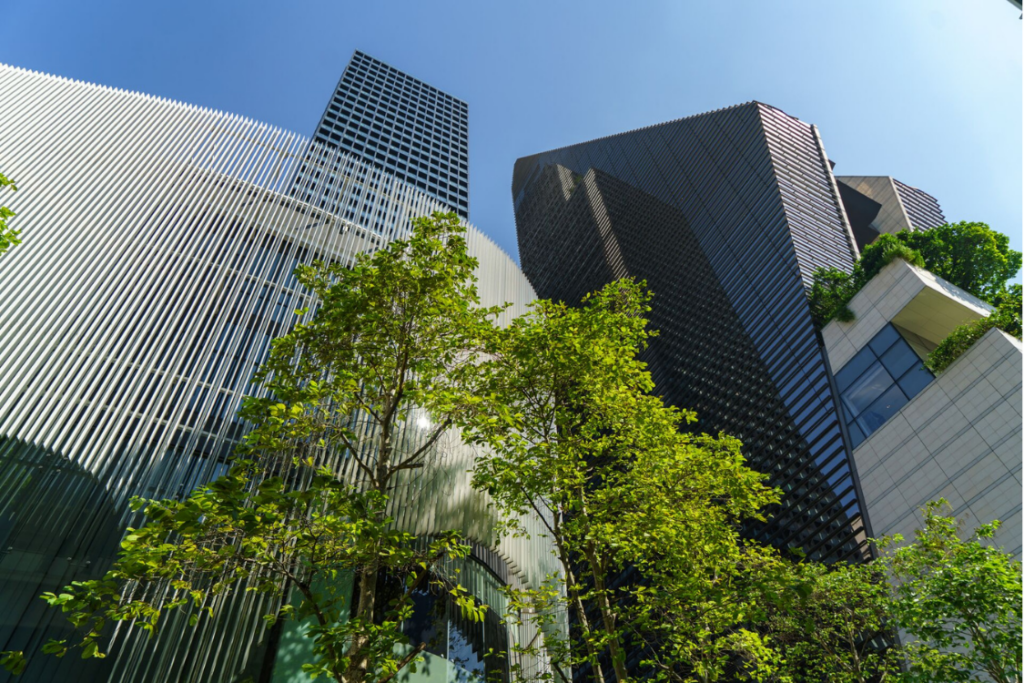
The client is the owner of a 5-acre, multi-tenant commercial technology campus in Hyderabad. The facility operates as a live, tenanted IT park, with corporate occupants across multiple floors running continuous business operations. For a building of this type, HVAC reliability and indoor air quality are direct determinants of tenant retention and occupancy rates.
The tech park has been in continuous operation for over a decade. Its chiller plant, three air-cooled units of 300 TR each, is the single largest energy cost on the building’s operating account, accounting for a substantial share of total electricity consumption year-round.
- Location: Hyderabad, Telangana (India)
- Facility: Multi-tenant commercial technology campus, live and fully tenanted during the upgrade
- Existing Chiller Plant:
- 3 × 300 TR fixed-speed air-cooled chillers (approximately 15 years old at time of upgrade)
- Fixed-speed primary and secondary chilled water pumps
- No modulation or load-tracking control; plant ran at constant output regardless of building demand
- Baseline Annual Energy Consumption: 32 lakh kWh
- Measured Plant SPC: 1.64 kW/TR
The Challenge
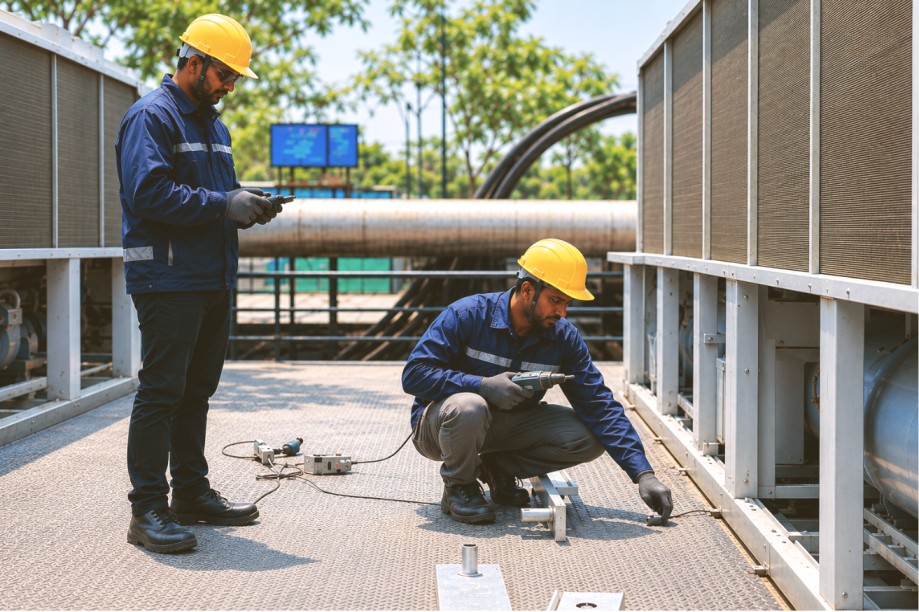
1. Why HVAC Efficiency Is the Commercial Real Estate Owner’s Largest Controllable Cost
HVAC systems account for 40–60% of total electricity consumption in commercial buildings in India, according to the India Cooling Coalition. In a technology campus where the plant runs continuously, through the night, through weekends, through peak Hyderabad summers, this is not an occasional cost. It is the dominant operating expense.
Most commercial buildings constructed between 2005 and 2012 still operate on the original chiller equipment installed at the time. That equipment was designed to the efficiency standards of its era. Those standards are no longer competitive. Modern variable-speed air-cooled chillers routinely achieve below 1.05 kW/TR under Indian operating conditions. Buildings running fifteen-year-old fixed-speed machines at 1.5 to 1.8 kW/TR are paying a structural premium on every kilowatt-hour consumed, not because of poor maintenance, but because the technology has moved.
2. The Specific Energy Consumption Gap
Specific energy consumption, measured in kW per ton of refrigeration (kW/TR), is the metric that answers the efficiency question precisely. A well-configured modern air-cooled chiller plant operating under Indian conditions delivers approximately 0.95–1.05 kW/TR as a best-in-class benchmark. The campus plant was measured at 1.64 kW/TR, a 39% premium over modern benchmarks. At 32 lakh kWh of annual consumption, this gap represented lakhs of rupees in annual recoverable cost.
3. Fixed-Speed Equipment and Variable Building Demand
All three of the campus chillers were fixed-speed machines. Fixed-speed chillers are designed for peak efficiency when running near full load. Commercial buildings, however, have variable cooling demand across hours, seasons, and occupancy patterns. ASHRAE Standard 90.1 mandates VFD controls on chillers precisely because of part-load inefficiency; fixed-speed units draw near-full power even when demand is a fraction of capacity.
In Hyderabad’s climate, with distinct summer, monsoon, and mild winter seasons, a commercial HVAC plant will spend the majority of its operating hours at partial load. A fixed-speed plant has no mechanism to respond to this. It runs flat out regardless. The result is consistent, avoidable over-consumption during every hour the building is not at peak demand, which is most hours.
4. The Absence of Real-Time Performance Data
The plant had no flow meters. No energy monitoring. No live kW/TR tracking. The engineering team could see the electricity bill; they could not see where within the plant the consumption was concentrated or how performance was drifting over time. Without a verified, independently measured baseline, no rigorous savings calculation was possible, and without that, no credible investment case could be built.
This is a common condition across Indian commercial real estate. The problem is not a lack of awareness that chillers age. It is the absence of the instrumentation needed to quantify the opportunity precisely enough to act on it with confidence.
The Solution
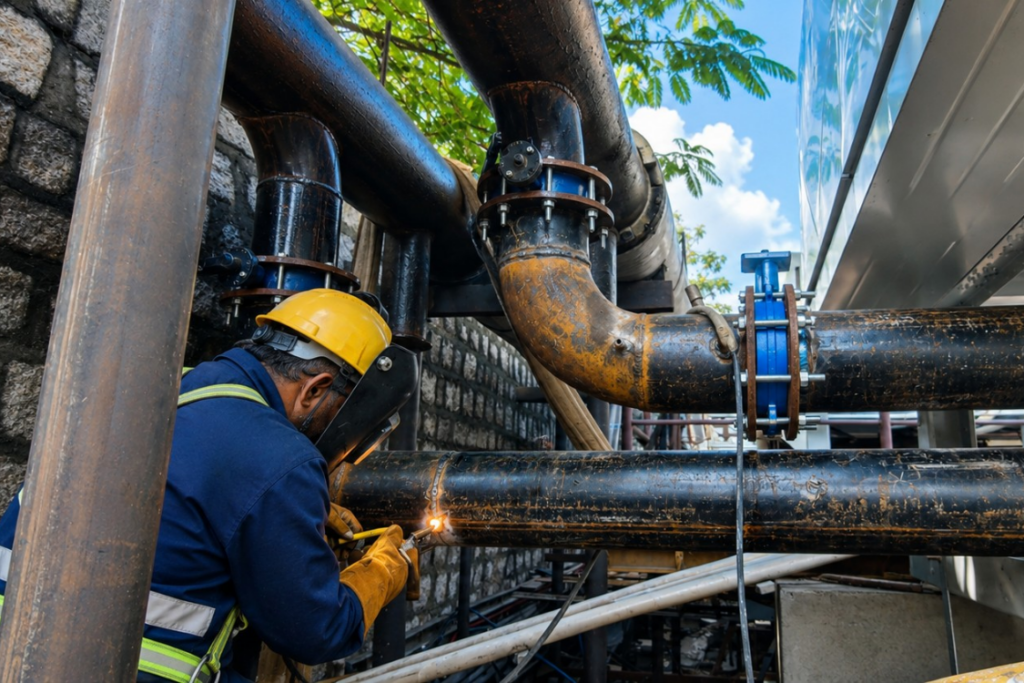
Energeia’s approach began with data collection. Before specifying any hardware, the team profiled the building’s actual cooling demand across occupancy patterns, seasons, and ambient temperature ranges. The question was not which chiller is best-in-class in a catalogue. It was the configuration which will perform best against this building’s specific load curve.
1. Variable-Speed Chiller Replacement
The three ageing fixed-speed 300 TR air-cooled chillers were replaced on a like-for-like capacity basis with three new 300 TR variable-speed air-cooled chillers. The critical distinction is the Variable Frequency Drive on each unit. Unlike the outgoing machines, which ran at constant compressor speed regardless of demand, the new chillers continuously adjust output to match the building’s actual cooling requirement at any given moment.
For a commercial campus with variable occupancy, lighter loads on evenings, weekends, and shoulder seasons, this is not a marginal improvement. It is a fundamental change in how the plant consumes energy. The compressor no longer draws peak power at 60% load. It draws only what the load actually requires.
2. Adiabatic Pre-Cooling on Condenser Air Intake
The performance of an air-cooled chiller is directly tied to the temperature of the air entering the condenser coils. In Hyderabad’s dry summer months, when ambient temperatures regularly exceed 40°C, condenser inlet temperature becomes a significant driver of compressor work and energy consumption.
An adiabatic pre-cooling system was installed on the condenser air intake of each chiller. The system uses evaporative cooling to reduce the temperature of incoming air before it reaches the condenser coils, without adding moisture to the building environment. During Hyderabad’s dry summer, where ambient humidity is low, this intervention consistently reduces effective condenser inlet temperature, lowering compressor lift and delivering measurable energy savings during the highest-consumption months. The first summer of operation confirmed the design worked as intended.
3. VFD-Driven Primary and Secondary Pumping
The chilled water distribution system was upgraded in parallel with the chillers. Fixed-speed primary and secondary pumps were replaced with VFD-driven units, and the header was re-optimised to match the hydraulic characteristics of the new plant. Pumping systems in a building of this size account for a material share of total HVAC energy consumption, and fixed-speed pumps carry the same fundamental inefficiency as fixed-speed chillers: they draw constant power regardless of the flow actually required at any moment.
The transition to variable-speed pumping, combined with header optimisation, ensures that hydraulic delivery is matched to building demand throughout the day and across seasons, eliminating the parasitic losses that are an inherent feature of fixed-speed pump operation.
4. Integrated Sequencing and Control
The three new chillers and their associated pumping systems operate as a single integrated plant, responding to a unified demand signal rather than running as independent units. Sequencing logic determines which chillers are active at any load level, staging them in and out as demand rises and falls across the day. This eliminates the over-running that was endemic in the old fixed-speed configuration, where all three units operated continuously regardless of actual demand.
Cooling-as-a-Service Model
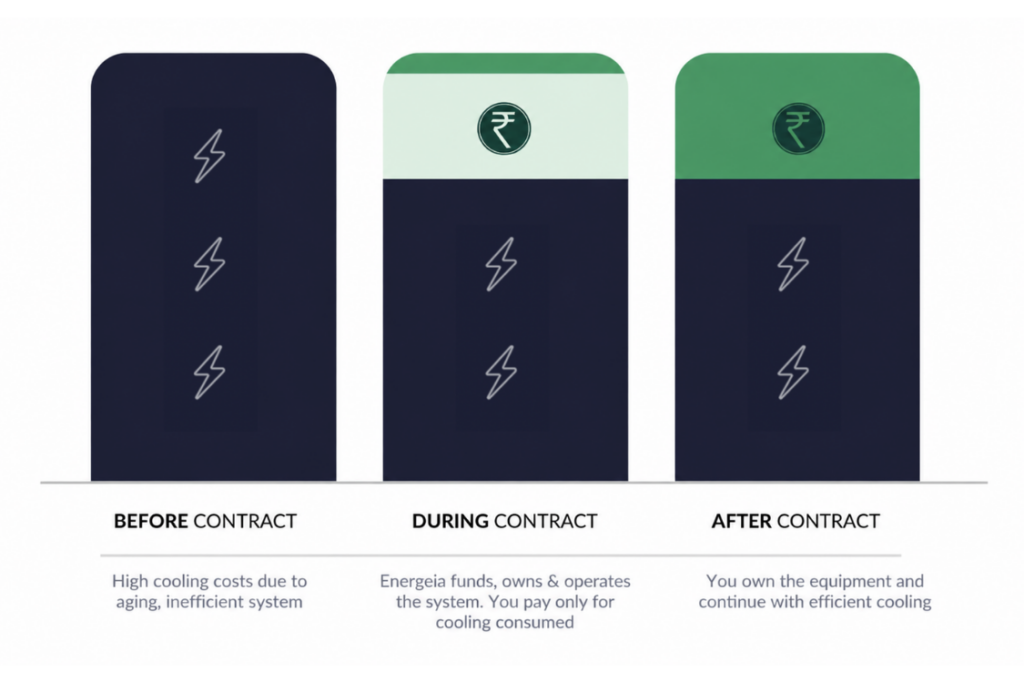
For the building owner, the efficiency opportunity was clear. The question was who funds it, who installs it, and who absorbs the risk that the plant does not perform as designed.
Under Energeia’s E-Chill cooling-as-a-service model, the answer to all three questions is Energeia.
- Energeia completely funded the entire HVAC upgrade. The client contributed zero rupees of upfront investment.
- Energeia owns and operates the equipment for the duration of the eight-year contract, and charges the client only for cooling delivered, on a cost-per-ton-hour (₹/TR-hr) basis.
- Maintenance, servicing, and performance monitoring are Energeia’s responsibility throughout the contract period. The owner has no operational liability for the plant.
- All assets transfer to the building owner in full operational condition at the end of the eight-year term, at no additional cost.
Curious about the Cooling-as-a-service model? Learn more here.
Results
The upgraded plant brought the campus chiller SPC from 1.64 kW/TR to 1.00 kW/TR — a 39% efficiency improvement that flows directly through to every metric below. Six months of verified billing have confirmed the performance against a contractual baseline independently measured before installation.
| Metric | Before (Old System) | After (New System) | Improvement |
|---|---|---|---|
| Plant Specific Energy Consumption | 1.64 kW/TR | 1.00 kW/TR | ↑ 39% More Efficient |
| Annual Chiller Plant Energy Use | 32,00,000 kWh | ~20,30,000 kWh | ↓ 11,70,000 kWh Saved |
| Annual Energy Cost Savings | Baseline | – | ↓ ₹1.1 Crore+ Saved |
| Chiller Capacity / Control | 3 × 300 TR fixed-speed (no modulation) | 3 × 300 TR VFD + adiabatic pre-cooling | ↑ Full variable-speed operation |
| Upfront Investment from Client | ₹0 (Energeia funded) | ✓ Zero capex |
Key Takeaways
- Air-cooled chillers older than 10 years likely operate above 1.3 kW/TR. Best-in-class VFD air-cooled chillers achieve below 1.0 kW/TR. The gap is recoverable savings.
- VFD chillers cut energy consumption by 25–40% in commercial buildings. Variable-speed compressors match output to actual cooling demand; fixed-speed machines cannot.
- Adiabatic pre-cooling reduces chiller energy consumption in hot, dry climates. In Hyderabad summers above 40°C, lowering condenser inlet air temperature directly reduces compressor work and electricity draw.
- IoT energy monitoring converts monthly bills into real-time kW/TR data. Live performance tracking detects efficiency drift the moment it begins, not months later.
- Under Energeia’s Cooling-as-a-Service model, the building owner pays nothing upfront; Energeia funds, owns, and operates the plant, and charges only for cooling delivered.
Frequently Asked Questions
At this campus, Energeia identified and delivered ₹1.1 Crore+ in annual chiller plant energy savings, a 39% reduction in system energy consumption. The chiller plant accounted for the dominant share of the building’s electricity bill. For commercial buildings running air-cooled chillers older than ten years at above 1.2 kW/TR, savings of 25–40% of chiller electricity costs are consistently achievable. A detailed audit with IoT baseline measurement quantifies the opportunity precisely before any commitment is made.
kW/TR (kilowatts per ton of refrigeration) measures how much electricity a chiller uses to deliver one ton of cooling. Lower is better. Best-in-class for a modern VFD air-cooled chiller under Indian operating conditions is approximately 0.95–1.05 kW/TR. The campus plant was running at 1.64 kW/TR before the upgrade, 16.4% above benchmark. After installation of three new VFD air-cooled chillers with adiabatic pre-cooling, the plant reached 1.00 kW/TR, saving 11.7 lakh kWh annually.
VFD chillers are substantially more efficient at partial loads, and partial load is where commercial buildings spend most of their operating hours. Replacing fixed-speed machines with variable-speed units is the primary intervention for buildings with variable occupancy and cooling demand. At this campus, the move from three fixed-speed 300 TR chillers to three VFD units was responsible for the majority of the 39% efficiency gain. The right specification depends on the building’s actual load profile, which is why an audit that captures real demand data before any procurement decision is essential.
An Energy-as-a-Service (EaaS) company funds, installs, and operates energy efficiency upgrades with no upfront investment from the building owner. Under Energeia’s Cooling-as-a-Service model, Energeia deploys its own capital, owns the equipment, and takes full performance and maintenance risk for the duration of the contract. Energeia charges the building owner on the basis of cost per ton-hour (₹/TR-hr) of cooling actually delivered.
No, if the installation is correctly sequenced. Energeia’s execution model keeps the legacy plant on hot standby throughout commissioning, ensuring full cooling coverage is maintained at every stage. Heavy lifts and pipework cut-overs are conducted outside business hours, at night and on weekends. At this campus, the six-week installation window was completed with zero tenant complaints recorded. Zero disruption to occupied building operations is a contractual commitment, not a target.