



Energy as a Service (EaaS) is a model where a specialist provider designs, funds, installs, operates, and maintains energy-generating equipment chillers, compressors, boilers, HVAC at your facility, and you pay only for the output you consume per ton of cooling, per kWh, per unit of compressed air. There is no capital outlay, no new asset on your balance sheet, and no operational burden; the provider carries the equipment and the efficiency risk instead of you.
With a traditional capex purchase, you own the equipment and carry the maintenance, performance, and efficiency risk. With Energy as a Service, the provider owns the equipment and carries that risk; you simply pay for the output you use.
Your chiller plant is 12 years old, your maintenance team is already stretched thin, and every quarter you ask finance for capex to replace it. Every quarter, it gets pushed to “next year.” Meanwhile, the electricity bill keeps climbing, and nobody can say for sure how much of that is the plant just getting old and inefficient.
Sound familiar? That’s exactly the problem Energy as a Service (EaaS) was built to solve.
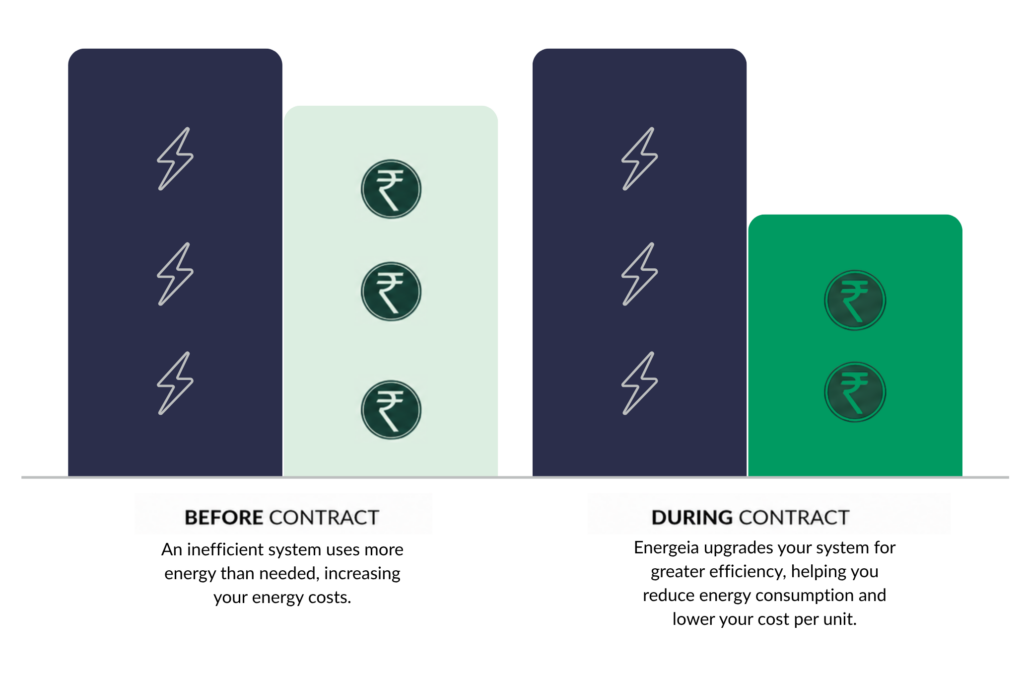
Because the plant is purpose-built and run by a specialist whose only job is to keep it efficient, the rate you pay per unit is typically lower than what it actually costs you to run an older, in-house system today, once you add up the inefficiency, the ad hoc maintenance, and the idle capacity steadily padding your energy bill.
At Energeia, this is one of the ways we help energy-intensive manufacturers get modern, efficient equipment on-site without taking on the capital cost or the operational headache of owning it themselves.
How Big Is the Energy as a Service Market?
The global EaaS market was valued at roughly USD 64.34 billion in 2021 and is projected to reach approximately USD 147.56 billion by 2029, growing at a compound annual rate of about 11.1%, according to Fortune Business Insights. That growth is being driven by exactly the pressures Indian manufacturers are facing right now: energy costs that keep climbing, tightening emissions and compliance requirements, and a shortage of in-house capital or engineering bandwidth to run a modernization program on top of running the plant itself.
For energy-intensive sectors like pharmaceuticals, food processing, cement, textiles, automotive, metals, and chemicals, this shows up as a specific, familiar problem: the equipment that would cut your energy costs the most (chillers, compressors, boilers, HVAC systems) is also the equipment most plants can’t justify replacing on their own capital budget, because the payback math competes with core production investment every single year. EaaS exists to remove that trade-off entirely.
Why Are Manufacturers Adopting an Energy as a Service Model?
Talk to enough plant heads, CFOs, and sustainability leaders, and the same three frustrations come up again and again:
1. Capital is scarce, and energy infrastructure always loses. A new chiller plant or compressor upgrade almost always pays for itself over time, but it still must compete against new production lines and capacity expansion for the same rupee of capex. It rarely wins.
2. Running old equipment is a full-time distraction from running the plant. Maintenance teams already stretched thin end up firefighting an ageing boiler or a leaky compressor system instead of focusing on the thing they’re actually there to do: keep production running.
3. Energy costs need to be predictable, not reconstructed after the fact. Finance teams want a clean, forecastable number, not a capital asset with an unpredictable maintenance trajectory five years down the line.
Energy as a Service is built to answer all three at once: no capex, no ownership, no operational burden, just a predictable per-unit bill for exactly the output your plant needs.
How Does Energeia’s Energy as a Service Model Work?
1. We start with a facility-wide audit. Before anything gets designed, we study your entire facility – every compressor, chiller, boiler, and HVAC system – to understand your actual output requirement, where energy is being wasted today, and what “efficient” really looks like for your operation. This is the step that makes everything after it accurate instead of guesswork.
2. Assessment and system design. We study your facility’s actual output requirement, refrigeration load, compressed air demand, heating requirement and design a plant to deliver it, sized to your operation rather than retrofitted around old equipment.
3. Energeia funds and installs the asset. Equipment, controls, and IoT monitoring infrastructure are procured, installed, and commissioned entirely at Energeia’s cost. Nothing goes on your capex line.
4. Energeia operates and maintains it. Day-to-day operations, preventive and predictive maintenance, spares, and performance tuning are ours to manage for the length of the contract – a turnkey commitment, not a one-time installation.
5. Real-time monitoring tracks output. IoT-based metering measures exactly what you consume: tons of refrigeration delivered, kWh generated, cubic meters of compressed air supplied.
6. You’re billed for what you used. A recurring, predictable, per-unit invoice, no capital request, no maintenance emergency, no guesswork.
What Does Energy as a Service Mean for Your CFO, Plant Head, and Sustainability Team?
Different people in your organization are going to care about different parts of this, so let’s break it down by who’s asking:
1. If you’re the CFO or in procurement: the upgrade is off-balance-sheet and zero capex. No asset to depreciate, no competition with core production investment for capital. You’re converting an unpredictable capital decision into a predictable operating line, one that’s typically lower than the blended cost of energy, maintenance, and capital carrying costs of running the equivalent equipment in-house.
2. If you’re the plant head or operations leader: uptime and maintenance responsibility move to us. Your team stops firefighting ageing chillers, compressors, or boilers, and gets a plant that’s engineered and maintained specifically to hit your output requirement, with reliability accountability sitting on the provider.
3. If you’re running sustainability or ESG: you get access to efficient, modern equipment without the capital outlay that usually stalls decarbonization plans. That makes it a lot easier to hit emissions and energy-intensity targets on the timeline your ESG reporting actually demands.
4. If you’re the energy manager: metering is granular and continuous, so you can see consumption and cost in real time instead of reconstructing it after you get the invoice.
How Much Can Energy-as-a-Service Actually Save You?
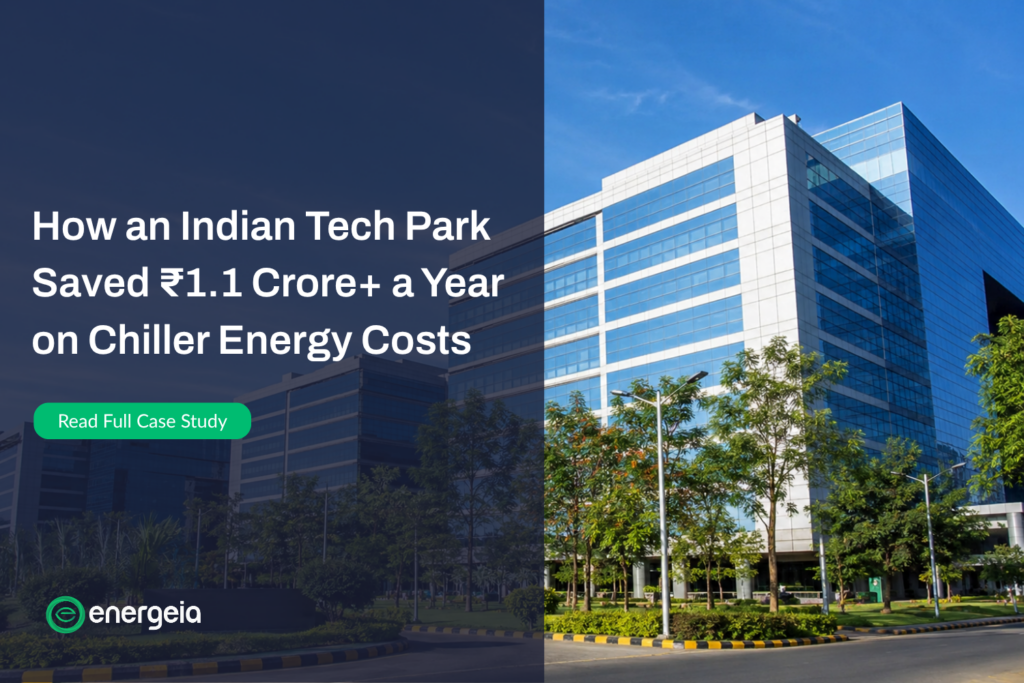
Numbers make this easier to picture than any explanation. Take a recent Energeia project: How an Indian Tech Park Saved ₹1.1 Crore+ a Year on Chiller Energy Cost, With Zero Capital Spent Under Energy as a Service Model with Energeia
Is Energy as a Service the Same as the Capex Model?
Not at all; this is actually the model EaaS moves furthest away from. Under traditional capex ownership, you buy the equipment outright, it sits on your balance sheet, and you carry all the maintenance and performance risk yourself. Under Energy as a Service, Energeia owns the equipment, carries that risk instead, and bills you a straightforward per-unit rate. Read the full comparison in Energy as a Service vs Traditional Energy Models.
Frequently Asked Questions About Energy as a Service
Energy as a Service is a model where a provider owns, operates, and maintains energy-generating equipment on a customer’s site, and the customer pays only for the output consumed per ton of cooling, per kWh, or another output-based unit.
Energeia owns the equipment for the duration of the contract. That keeps the asset off your balance sheet and puts all maintenance and performance responsibility on us.
No. Energeia funds the design, procurement, and installation of the equipment. Your only ongoing cost is the per-unit bill for what you actually consume.
We are, fully. Operations, preventive maintenance, and performance of the equipment are Energeia’s responsibility for the entire life of the contract.
Energy-intensive manufacturing sectors: pharmaceuticals, food processing, cement, textiles, automotive, metals, and chemicals, basically anywhere refrigeration, compressed air, or heating is a major, continuous energy cost.
In most cases, yes. Because the plant is purpose-designed for efficiency and professionally operated and maintained, the per-unit rate is typically lower than the combined cost of energy, maintenance, and capital carrying costs of running an older or undersized system in-house. For a brand-new facility, that means a lower effective energy cost from day one compared to building and running an equivalent system on your own.
Both get you modern equipment, but they differ in who owns it and who carries the risk. Under a Capex model, you buy the equipment outright and carry the cost, maintenance, and performance risk yourself. Under Energy as a Service, the provider owns the equipment and carries that risk instead, and you pay a per-unit rate.